How to Plan Exterior Masonry on a Budget: A Professional 2026
Exterior masonry is often perceived as the apex of construction expenses, a luxury reserved for institutional monuments or high-end residential estates. This perception is rooted in the historical reality of stone—its immense weight, the specialized labor required for its shaping, and the logistical complexities of transporting mineral mass from quarry to site. However, the modern architectural landscape has introduced a variety of systemic efficiencies that challenge the notion of masonry as an inherently cost-prohibitive choice. How to Plan Exterior Masonry on a Budget. When viewed through a lifecycle lens, masonry’s durability—its resistance to fire, rot, and UV degradation—often renders it more economical than “cheaper” cladding options that require frequent replacement or intensive maintenance.
The strategic challenge lies in the transition from viewing masonry as a raw material to viewing it as a managed assembly. A “budget” in masonry is not merely a constraint on the purchase price of the brick or stone; it is a calculation of structural efficiency, labor optimization, and waste mitigation. To plan effectively is to understand the interplay between the “modular” nature of masonry units and the labor-intensive reality of “field-cutting.” Every deviation from standard dimensions and every complex architectural flourish adds exponential costs that are often invisible during the initial design phase.
This editorial exploration establishes a definitive framework for achieving aesthetic authority without fiscal exhaustion. We will move beyond superficial cost-cutting tips to analyze the structural physics and logistical strategies that define high-value masonry planning. By treating the building envelope as an integrated system rather than a collection of expensive parts, stakeholders can deliver structures that possess the gravitas of traditional stonecraft while remaining within the rigorous confines of a modern project budget.
Understanding “how to plan exterior masonry on a budget”
Mastering how to plan exterior masonry on a budget requires a departure from the “unit-price” fallacy. Many planners focus exclusively on the cost per thousand bricks or the square-foot price of a stone veneer, neglecting the fact that labor and structural backup systems typically account for 60% to 75% of the total wall cost. A truly economical masonry plan prioritizes “Installation Velocity.” This involves selecting materials and patterns that allow a mason to maintain a high rate of production without being hindered by complex detailing, non-standard mortar joints, or excessive scaffolding resets.
Oversimplification in this sector frequently leads to the “Thin-Veneer Trap.” While thin-cut natural stone is lighter and appears easier to install, the precision required for the substrate and the specialized adhesives needed can sometimes bridge the cost gap with traditional full-bed masonry. A multi-perspective understanding recognizes that “budget” masonry is often about “Massing Efficiency.” By using expensive stone for visible “focal points” (like entrances or water tables) and utilizing more cost-effective modular brick or architectural CMU (Concrete Masonry Units) for the larger, secondary elevations, a project can achieve a high-prestige aesthetic at a fraction of the cost of a uniform stone facade.
Furthermore, we must address the “Module Alignment” principle. Masonry units have fixed dimensions. If a building’s window openings and wall heights are not planned to align with these increments, every corner and every opening will require the mason to hand-cut a unit. This produces not only labor delays but also significant material waste. A rigorous budget plan begins on the drafting table, ensuring that the building’s geometry respects the “Grid of the Unit.” When the design fits the material, the cost per square foot drops naturally as the speed of execution rises.
Deep Contextual Background: The Industrialization of Stone
Historically, the cost of masonry was dictated by the proximity of the quarry. Towns built near limestone deposits used limestone; those near clay pits used brick. The “Value Engineering” of the 19th century was simply a matter of local availability. With the advent of the rail system and later the interstate highway, the geographic constraints on masonry vanished, but they were replaced by “Energy Constraints.” The cost of masonry is now a reflection of the fuel required to bake clay or the carbon-intensive process of quarrying and sawing granite.
The 20th century introduced the “Cavity Wall,” which decoupled the masonry from the building’s structural load. This was the most significant cost-saving evolution in the history of the trade. It allowed for the use of “Veneers”—thin layers of masonry that provide the aesthetic and weather protection of stone without the need for massive, multi-foot-thick foundations. Today’s budget planning is a continuation of this trend, moving toward “Rainscreen” systems and “Adhered Veneers” that further reduce the structural weight and the associated costs of steel lintels and heavy-duty footings.
Conceptual Frameworks and Mental Models
To optimize masonry expenditures, professionals utilize specific mental models:
-
The Modular Rhythm Model: Treat the building as a sequence of masonry units. Any design element that breaks the rhythm (e.g., a non-standard window width) is a “Cost Spike.” Aligning the design to the material’s native rhythm is the foundation of fiscal discipline.
-
The 80/20 Visual Hierarchy: Direct 80% of the premium material budget toward the areas that will be viewed from within 10 feet of the structure. The remaining 80% of the building surface (the upper floors or rear elevations) should utilize high-quality but lower-cost modular units.
-
The Gravity-Path Framework: Evaluate every stone or brick based on how it is supported. Masonry that “hangs” (requires steel lintels) is always more expensive than masonry that “sits” (is supported by the foundation). Minimizing “suspended” masonry is a primary driver of budget success.
Key Categories of Masonry Systems
The selection of a masonry system is the most significant decision in the planning process.
| Category | Initial Cost | Labor Complexity | Maintenance Profile | Best Use Case |
| Modular Face Brick | Low – Moderate | Low (Predictable) | Extremely Low | Large-scale residential/commercial |
| Thin Stone (Adhered) | Moderate | Medium | Moderate | Retrofits; weight-sensitive areas |
| Full-Bed Natural Stone | High | High (Specialized) | Low | High-end focal points; foundations |
| Architectural CMU | Very Low | Low | Moderate | Industrial or modern aesthetics |
| Cast Stone / Precast | Moderate | Medium | Low | Repeating decorative elements |
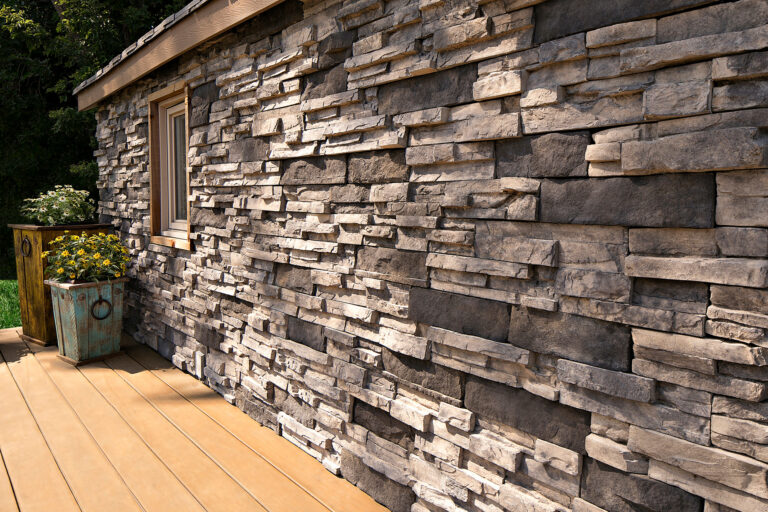
| Manufactured Stone | Low | Low | High (Fading/Durability) | Short-term budget solutions |
Decision Logic: The “Foundation-Up” Filter
When deciding how to plan exterior masonry on a budget, the first question should be: “Does the existing foundation support the weight?” If a project requires a new foundation ledge to support full-bed stone, the cost of the concrete work may exceed the cost of the stone itself. In such cases, switching to an adhered thin veneer—which can be supported by the wall structure itself—is the only logical fiscal path.
Detailed Real-World Scenarios How to Plan Exterior Masonry on a Budget
Scenario 1: The Commercial Strip Renovation
A developer wants to upgrade a 5,000 sq. ft. concrete block building to look like premium limestone.
-
The Constraint: The building cannot support the weight of real stone slabs.
-
The Budget Plan: Utilize a “Cast Stone” ashlar pattern for the first 4 feet (the water table) where people can touch the material, and use a high-quality EIFS or metal panel for the upper sections.
-
Outcome: The building achieves a “high-end” street-level presence for 40% of the cost of a full-stone wrap.
Scenario 2: The Residential Custom Home
The client insists on “Granite,” but the budget is fixed.
-
The Diagnostic: The original design featured granite “Quoins” (corner stones) and window surrounds on all sides.
-
The Budget Plan: Consolidate the granite to the front entrance and the chimney. Use a matching “Tumbled Brick” for the remaining walls.
-
Failure Mode: Using a cheap “Manufactured Stone” (concrete cast in molds) across the entire house, which would begin to show aggregate wear and color fade within seven years.
Planning, Cost, and Resource Dynamics
The economic landscape of masonry is defined by the “Labor-to-Material Ratio.”
| Component | % of Total Budget | Variability Drivers |
| Raw Material (Units) | 25% – 35% | Origin, rarity, shipping distance. |
| Mortar & Accessories | 5% – 10% | Custom colors, specialized ties/anchors. |
| Labor (Laying) | 40% – 50% | Pattern complexity, height (scaffolding). |
| Equipment/Cleanup | 10% – 15% | Site accessibility, waste disposal. |
Range-Based Analysis: A standard modular brick wall might cost $15 – $25 per square foot installed. A full-bed natural fieldstone wall can easily exceed $80 – $120 per square foot. The “Budget” zone typically sits between $30 and $50 per square foot, achieved through a blend of “Premium Focal Points” and “Modular Body Work.”
Tools, Strategies, and Support Systems
-
Modular Design Software: Using BIM (Building Information Modeling) to ensure every window and door falls on a “half-brick” increment.
-
Local Quarry Sourcing: Reducing “Freight-on-Board” (FOB) costs, which can represent 20% of the material price for heavy stone.
-
Pre-Blended Mortar: Eliminating on-site mixing errors that lead to color inconsistency and expensive “Acid Washing” cleanup.
-
Adjustable Masonry Ties: Allowing the mason to bridge the gap between the backup wall and the veneer quickly, reducing labor time.
-
Mast-Climbing Platforms: For large projects, these are 30% more efficient than traditional pole scaffolding, allowing masons to stay at the “perfect work height.”
-
Stone Surpluses and “B-Grade” Lots: Sourcing “remnant” lots from quarries for smaller projects where slight color variations add to the “rustic” charm.
-
Standardized Lintel Systems: Avoiding custom-engineered steel by designing openings that fit off-the-shelf L-angles.
Risk Landscape and Failure Modes
Budget-focused masonry is particularly susceptible to “Value Engineering” that compromises the building’s lifespan.
-
The Flashing Failure: Reducing costs by using inferior plastic flashing instead of copper or high-grade stainless steel. This leads to internal water damage that costs 10x the savings to repair.
-
The “Short-Tie” Risk: Using fewer masonry ties than code requires to save on labor/material. This can lead to “Veneer Collapse” during high-wind events.
-
Color Drift: Purchasing masonry in multiple small batches rather than one single “Run.” This results in visible “banding” across the building as the clay or stone colors shift slightly between batches.
Governance, Maintenance, and Long-Term Adaptation
A budget masonry project is only successful if it doesn’t become a maintenance liability.
-
Annual Inspection: Checking “Weep Holes” for blockages. A clogged weep hole traps water in the cavity, leading to efflorescence (salt staining) and freeze-thaw damage.
-
Repointing Cycle: Planning for a 20-year repointing cycle. Using a mortar that is softer than the brick ensures that when the building shifts, the mortar cracks—not the brick.
-
Vegetation Control: Preventing ivy or climbing plants from attaching to the masonry. The “root-anchors” of these plants secrete acids that dissolve mortar and penetrate stone pores.
Measurement, Tracking, and Evaluation
-
Leading Indicator: “Units Laid Per Man-Day.” If this falls below the project estimate, the design is likely too complex for the budget.
-
Lagging Indicator: The amount of “Waste Pallets” at the end of the job. High waste indicates a failure in modular planning.
-
Qualitative Signal: Mortar color consistency across different elevations and batches.
Documentation for Asset Longevity
-
The “Brick Receipt”: Keeping the specific manufacturer and color code for future repairs.
-
The Flashing Map: Photos of the wall cavity before it is closed to verify the location of all water-management components.
Common Misconceptions
-
“Natural stone is always better than brick.” Not for a budget. High-quality brick is often more durable and easier to install than low-quality, porous stone.
-
“You save money by doing your own stone-cutting.” Field-cutting is slow and produces dust. Sourcing pre-cut “Dimensional Stone” is almost always cheaper when labor is factored in.
-
“Mortar color doesn’t matter.” Mortar represents 20% of the wall’s surface area. A standard grey mortar is cheap, but a “Complementary Color” can make an inexpensive brick look like a premium one.
-
“Masonry is waterproof.” It is a sponge. The “Budget” must include a high-quality water-resistive barrier (WRB) behind the stone.
-
“Manufactured stone is a long-term asset.” Most manufactured stones are concrete-based and will lose their surface pigments over 15-20 years.
-
“Thicker joints save money.” Wide mortar joints take longer to “strike” and use more material; they are rarely a cost-saving measure.
Ethical and Practical Considerations
Exterior masonry planning on a budget also involves the ethics of “Material Origin.” Sourcing stone from quarries with poor labor practices or high environmental degradation may lower the “sticker price” but carries a high social cost. Furthermore, the “Practicality of Repair” must be considered; if a custom-mixed brick is used and the manufacturer goes out of business, future repairs will be impossible to match. Choosing “Standard Production Runs” from established manufacturers is the most ethical and practical way to ensure a building’s long-term viability.
Conclusion: The Discipline of the Stone
The ultimate secret of how to plan exterior masonry on a budget is the rejection of the “faux.” True value is found in using honest materials in a way that respects their physical properties and the human labor required to lay them. A structure built with a modest but high-quality brick, planned with modular precision, and executed with clean detailing will always outlast and outclass a structure covered in a complex, expensive stone veneer that was poorly planned. Masonry is the ultimate “slow” building material; its beauty and its budget are both realized through the discipline of the plan and the patience of the execution.